
Sri Lanka
Executive Summary
Sri Lanka – the “Pearl of the Indian Ocean” – is a compact island nation famed for its rich culture, diverse landscapes and friendly people. From the bustling capital of Colombo and the colonial charm of Galle Fort to the misty hill-country of Nuwara Eliya and the jungles of Yala, Sri Lanka packs a lifetime of sights into a small space. Its 3,000-year history spans ancient kingdoms (Anuradhapura, Kandy), colonial eras, and a modern post-war tourism boom. Today most travelers will find Sri Lanka welcoming and easy to explore: residents primarily speak Sinhala or Tamil (with English widely understood), and about 70% are Theravada Buddhists. The climate is tropical and warm (temperatures roughly 17–33 °C year-round), with two monsoon seasons that bring rain to different parts of the island at different times. Its cuisine is famously fragrant and spicy (coconut curries, rice-and-curry meals, hoppers, kottu, fresh seafood and Ceylon tea), while its biodiversity is remarkable: tropical rainforests like Sinharaja (a UNESCO site) harbor many endemic birds and reptiles, and national parks shelter elephants, leopards, and other wildlife. Safety is generally good; petty crime exists, but political stability has returned since the end of the civil war (1983–2009). Most visitors from Western countries can obtain a 30-day tourist visa exemption (ETA) online. Overall, Sri Lanka offers international travelers a surprisingly varied and safe adventure: ancient temples, hill plantations, golden beaches, and wildlife safaris are all within reach.
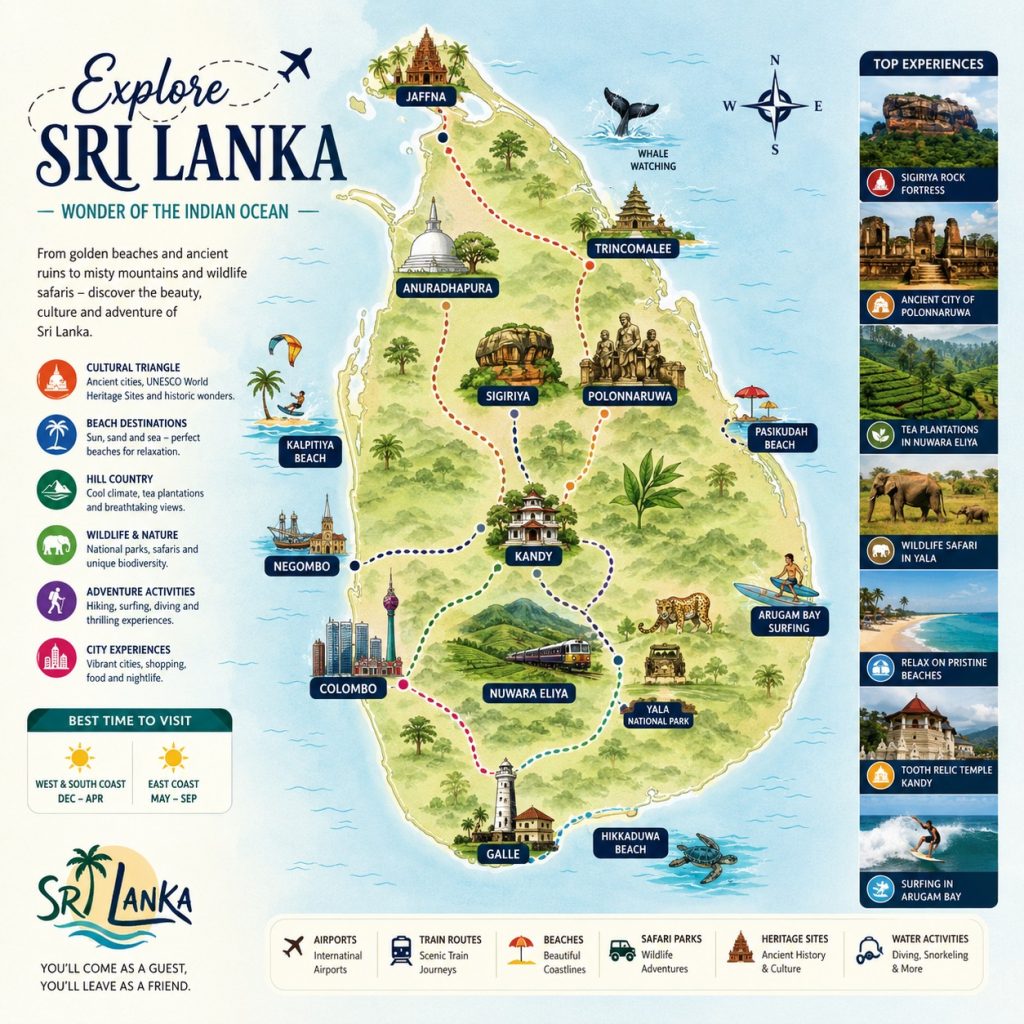

Popular Destinations
Colombo – Sri Lanka’s vibrant capital with colonial heritage, bustling markets, & oceanfront parks.
Colombo is the island’s largest city and commercial capital. Modern skyscrapers and shopping malls sit alongside colonial-era architecture (e.g. the Dutch-period Fort area) and colorful local markets. Key sights include Galle Face Green (a long seaside park), the historic Pettah market, Gangaramaya Temple (a richly decorated Buddhist temple), and the atmospheric Old Parliament (now a Presidential secretariat). Colombo also has museums (like the National Museum), upscale restaurants and beachfront promenades. The city is a convenient gateway: most visitors arrive via Bandaranaike Airport (near Colombo) and often spend 1–2 days here at start or end of their trip. Best time: December–March (dry season), as the city is wetter during the southwest monsoon (May–Sept). Top activities: stroll Galle Face at sunset, shop in Pettah bazaar, visit the Temple of the Tooth Relic’s satellite temple, try street food (kottu roti), and sunset drinks at rooftop bars. Tips: Traffic can be heavy; using ride-hailing apps (PickMe, Uber) or tuk-tuks is common. Stay hydrated – temperatures often reach low 30s°C. A suggested 1–2 nights is enough to see the main sites.
Kandy – Cultural capital in the hills; famous for the Temple of the Tooth and scenic lake.
Kandy lies in Sri Lanka’s central hills and is often called the cultural capital. It was the last seat of the ancient kings. The city center is built around a serene lake, with streets winding uphill to the famed Temple of the Sacred Tooth Relic, which houses a Buddha tooth (and is a UNESCO site). Kandy offers a cooler, misty mountain atmosphere. Highlights include the Royal Botanical Gardens (Peradeniya), Kandyan dance and drumming performances, and the evening Esala Perahera festival (July/August) when the city parades on decorated elephants. From Kandy one can easily day-trip to tea plantations and viewpoints above the city. Best time: December–April (avoid the central highlands’ wetter monsoon months of May–Sept). Top activities: visit the Temple of the Tooth, stroll Kandy Lake, enjoy a cultural show, explore nearby tea estates, and hike the nearby Royal Palace complex ruins or cloud-covered hills (e.g. Kandy Viewpoint). Tips: Temple etiquette requires modest dress and removing shoes. Expect crowds during perahera week. Allow 1–2 days here.
Galle Fort – UNESCO colonial port city with cobblestone streets, ramparts & beach cafes.
Galle is a historic fort city on the southwest coast. Galle Fort (UNESCO-listed) was built by the Portuguese and expanded by the Dutch. Today the 17th-century fort’s thick walls still stand around a grid of charming cobbled streets. Inside are colonial-era houses, boutique shops, art galleries, and mosques, churches, and temples reflecting its multicultural past. Walk the ramparts at sunset for Indian Ocean views. Outside the fort walls, sandy beaches (Unawatuna to the west) and picturesque lighthouses await. Best time: December–March (dry season on the southwest coast). Top activities: explore Galle Fort’s bastions and old Dutch Reformed Church, shop for local crafts, dine in seaside cafes, and swim or snorkel at Unawatuna/Mirissa beaches nearby. Tips: Bring a sunhat for wall-top walks. The fort can be very busy during daytime; mornings or late afternoons are most pleasant. Plan 1–2 days in Galle (more if combining with beach time).
Ella – Mountain village and trekking hub amid tea plantations; home to the Nine Arch Bridge and Little Adam’s Peak.
Ella is a small town high in the central highlands, popular with nature lovers for its scenic hikes. It’s surrounded by green tea hills and waterfalls. The must-do Nine Arch Bridge trek (a majestic colonial viaduct) and the climb of Little Adam’s Peak (an easy hilltop trek) offer panoramic views. Ella also serves as a base to explore Ella Gap and nearby tea estates (like the 19th-century Dunsinane or Halpe estates). Best time: December–March (the dry season brings clear skies). Top activities: hike to the Nine Arch Bridge (often catching a passing train in frame), trek Little Adam’s Peak or Ella Rock, visit Ravana Falls, and tour a tea factory. The famous scenic train route from Kandy to Ella is a highlight. Tips: The highland mornings can be chilly – dress in layers. Trains can be crowded; book tickets in advance for panoramic-seat compartments. A couple of nights are recommended to do key treks without rushing.
Sigiriya – Ancient fortress “Lion Rock” and gateway to Sri Lanka’s Cultural Triangle.
Rising dramatically from the Central Province plains is Sigiriya, a towering rock fortress crowned by a ruined palace (a UNESCO World Heritage Site). At its base are the remains of elaborate water gardens and frescoes of the “Sigiriya maidens” halfway up the cliff. It offers one of Sri Lanka’s most iconic views. Sigiriya sits in the heart of the “Cultural Triangle,” a region of ancient sites. Nearby attractions include the cave temples of Dambulla (colorful Buddhist murals), and the medieval capitals of Polonnaruwa and Anuradhapura. Best time: Late December–April is ideal (Sigiriya can get muddy in the heavy rains of May–Oct). Top activities: climb Sigiriya Rock early to avoid heat and crowds, tour the water gardens, visit nearby Minneriya National Park (famous for “Gathering” of elephants July–Oct), and explore the Dambulla Cave Temple. Tips: Wear sturdy shoes for the climb. Arrive at Sigiriya in early morning or late afternoon for cooler weather and to see the light on the rock. 1–2 days in the Cultural Triangle suffice for key sites (Sigiriya + one of the ancient cities plus a safari).
Nuwara Eliya – “Little England” hill station in tea country, with cool climate and colonial charm.
Nuwara Eliya sits at ~1,900 m in the central highlands, offering a decidedly cooler climate and countryside atmosphere. It was developed by the British as a tea-plantation town (“Little England”). The town has colonial architecture (a red post office, golf course) and colorful flower gardens. Surrounding the town are emerald-green tea plantations and misty mountains. This area also includes Horton Plains National Park (with the epic “World’s End” cliff) and Adam’s Peak (sacred climb). Best time: December–March (to avoid heavy rain in the hills). Top activities: visit a tea factory (see how Ceylon tea is made), take a boat ride on Lake Gregory, stroll strawberry farms and Hakgala Botanical Gardens, hike in Horton Plains (World’s End and Baker’s Falls), or climb Adam’s Peak overnight (seasonal, December–April). Tips: Temperatures can drop sharply after sunset; bring a warm jacket. Nuwara Eliya has many mid-range resorts; it’s cooler than the coast by ~10°C. Plan 1–2 days here, more if hiking Horton or Adam’s Peak.
Yala National Park – Premier wildlife sanctuary (leopards, elephants, birdlife) in the arid south.
Yala NP is Sri Lanka’s most famous safari park, located in the southeast. Its dry plains, lakes and scrub forest provide habitat for a high density of wildlife. Notably, Yala has one of the world’s highest concentrations of wild leopards, as well as elephants, deer, crocodiles and hundreds of bird species. Safaris (4×4 jeeps with guides) at dawn or dusk are the norm. The park’s terrain varies from open grassland (ideal for spotting mammals) to sand dunes by the ocean. Best time: February–June, during the dry season when animals congregate at water holes (monsoon rains July–Sept make many trails muddy). Top activities: guided jeep safari to see wildlife (reserve an English-speaking guide), birdwatching at Bakamuna or Bundala (nearby wetlands), and night safaris if available. Tips: Book safaris in advance through your hotel or a reputable tour operator. Bring binoculars, sun protection and insect repellent. Often 2 full days are needed to see wildlife at Yala.
Anuradhapura – Sacred ancient capital with giant stupas and the Sri Maha Bodhi.
Anuradhapura (in North Central Province) is a vast archaeological site and former island capital of the Sinhalese kings. It is dotted with enormous brick stupas (dagobas), monasteries and palaces. The Sri Maha Bodhi (a sacred fig tree) is a highlight – it is said to be a cutting from the Buddha’s original Bodhi tree in India (and is one of the oldest known planted trees). Visitors typically rent bicycles or hire a vehicle to cover the sprawling ruins. Best time: December–April (avoid summer heat peaks and seasonal rains). Top activities: climb Jetavanaramaya or Ruwanweliseya stupas for views, see the twin islet palace on Nuwara Wewa reservoir, and browse the museum on site. The city has shaded pavilions to escape the midday sun. Tips: Dress modestly (Sarong rental available to cover legs at temples). One full day is enough to see the main sites of Anuradhapura.
Polonnaruwa – Medieval capital ruins, statues and irrigation marvels near Minneriya NP.
After Anuradhapura, the Sinhalese established Polonnaruwa as the next capital (10th–12th c.). The compact ruins include the regal palace, Shiva and Buddha statues (Gal Vihara rock temples), and engineered irrigation tanks and canals. It’s an easily walkable site or bicycle ride. Nearby, Minneriya National Park (in the dry zone) hosts Sri Lanka’s famous “Elephant Gathering” (hundreds of elephants at a reservoir in late dry season). Best time: December–April. Top activities: tour the Vatadage (circular relic house), see the reclining Gal Vihara Buddha carving, bike the ancient roads, and combine with an evening safari at Minneriya (just south of the city). Tips: Polonnaruwa is about 80 km from Anuradhapura – consider doing both in one trip. 1 day covers Polonnaruwa’s highlights well.

Sri Lanka Weather
Sri Lanka enjoys a tropical climate throughout the year, making it an ideal destination in every season.
| Season | Months | Weather |
|---|---|---|
| ☀️ Dry Season (West & South) | December – April | Perfect for beaches, sightseeing, whale watching, and water sports. |
| 🌦️ Southwest Monsoon | May – September | Rain mainly affects the southwest coast and hill country. |
| ☀️ East Coast Best Season | May – September | Sunny weather, ideal for Trincomalee, Nilaveli, Pasikuda, and Arugam Bay. |
| 🌧️ Northeast Monsoon | October – January | Rain mainly affects the north and east regions. |
| 🌿 Hill Country | Year-round | Cool temperatures (15°C–24°C), ideal for tea plantations and scenic train journeys. |
Average Temperatures
- Coastal Areas: 27°C – 32°C
- Hill Country: 15°C – 24°C
- Dry Zone: 28°C – 35°C
🌴 December – April (South & West Coast)
This is the perfect season to explore Sri Lanka’s sunny southern and western coastline.
Mirissa Beach – Whale watching, golden beaches, surfing, and stunning sunsets.
Galle Fort – UNESCO World Heritage fortress with colonial architecture.
Bentota Beach – Water sports, river safaris, and luxury resorts.
Nine Arch Bridge – One of Sri Lanka’s most iconic scenic viewpoints.
🌊 May – September (East Coast)
During these months, Sri Lanka’s east coast enjoys clear skies and calm seas.
- Nilaveli Beach – Crystal-clear waters and white sandy beaches.
- Pasikuda Beach – Shallow turquoise waters ideal for families.
- Arugam Bay – World-famous surfing destination.
- Pigeon Island National Park – Snorkeling, coral reefs, and tropical marine life.
🌿 Year-Round Destinations
These destinations can be enjoyed throughout the year and are among Sri Lanka’s top attractions.
- Sigiriya Rock Fortress – Ancient rock fortress and UNESCO World Heritage Site.
- Temple of the Tooth – Sri Lanka’s most sacred Buddhist temple.
- Nuwara Eliya – Tea plantations, waterfalls, and cool mountain climate.
- Yala National Park – Exciting wildlife safaris with leopards, elephants, and exotic birds.
These seasonal highlights help visitors experience the very best of Sri Lanka, whether they’re seeking pristine beaches, cultural landmarks, wildlife adventures, or scenic mountain escapes.